
Private nonresidential construction spending hit $755.2 billion SAAR as of July 2026, up from $752.4 billion the prior month, according to the U.S. Census Bureau's Monthly Construction Spending report. That scale reflects how much activity — and how much risk — sits inside this industry.
This guide covers project types, the construction process, financing basics, and how to choose a partner who won't derail your operations along the way.
Key Takeaways
- Plan for new builds, renovations, and tenant improvements across office, retail, industrial, and multifamily properties
- Map work through five phases: site evaluation, design/permitting, financing, construction, and completion
- Choose contractors for clear communication, not just craft—especially when your business stays open during work
- Set budget and schedule ranges by scope, project type, and local permitting rules
What Is Commercial Real Estate Construction?
Commercial real estate construction means building, renovating, or improving property meant for business or income-generating use, not residential living. Think offices, retail stores, warehouses, restaurants, and mixed-use developments.
Commercial projects usually fall into four types:
- Ground-up construction: building a structure from bare land
- Renovation: updating or reconfiguring an existing building
- Remodeling: cosmetic or functional upgrades to specific areas
- Tenant improvements: customizing a leased space for a specific business's needs

Who Needs Commercial Construction Services
Commercial construction serves a wide range of property types and business situations:
- Office owners and managers updating suites or common areas
- Industrial and warehouse operators reconfiguring floor space
- Retail owners refreshing layouts for new concepts
- Restaurant operators build-outs and remodels
- Landlords preparing vacant space for new tenants
Businesses going through expansion, rebranding, or lease turnover frequently need tenant improvement work. A new tenant rarely wants the same layout, flooring, or paint scheme as the last one. Landlords know a move-in-ready space attracts better tenants faster.
Types of Commercial Construction Projects
Commercial construction generally falls into these categories: office, retail, industrial, institutional, mixed-use, hospitality, and healthcare or special-purpose buildings. Each comes with distinct code requirements, timelines, and design considerations.
Concrete examples of commercial construction projects include:
- A retail store buildout for a new location
- An office renovation to modernize a leased suite
- A restaurant remodel with new kitchen infrastructure and dining layout
- A warehouse expansion to add storage or shipping capacity
New Construction, Renovation, Tenant Improvement, and Site Work
These terms get used loosely, but they mean different things:
- New construction starts from the ground up
- Renovation updates an existing structure's systems, finishes, or layout
- Tenant improvement customizes a space for one specific occupant's operational needs
- Exterior/site work covers parking lots, concrete surfaces, fencing, and traffic striping
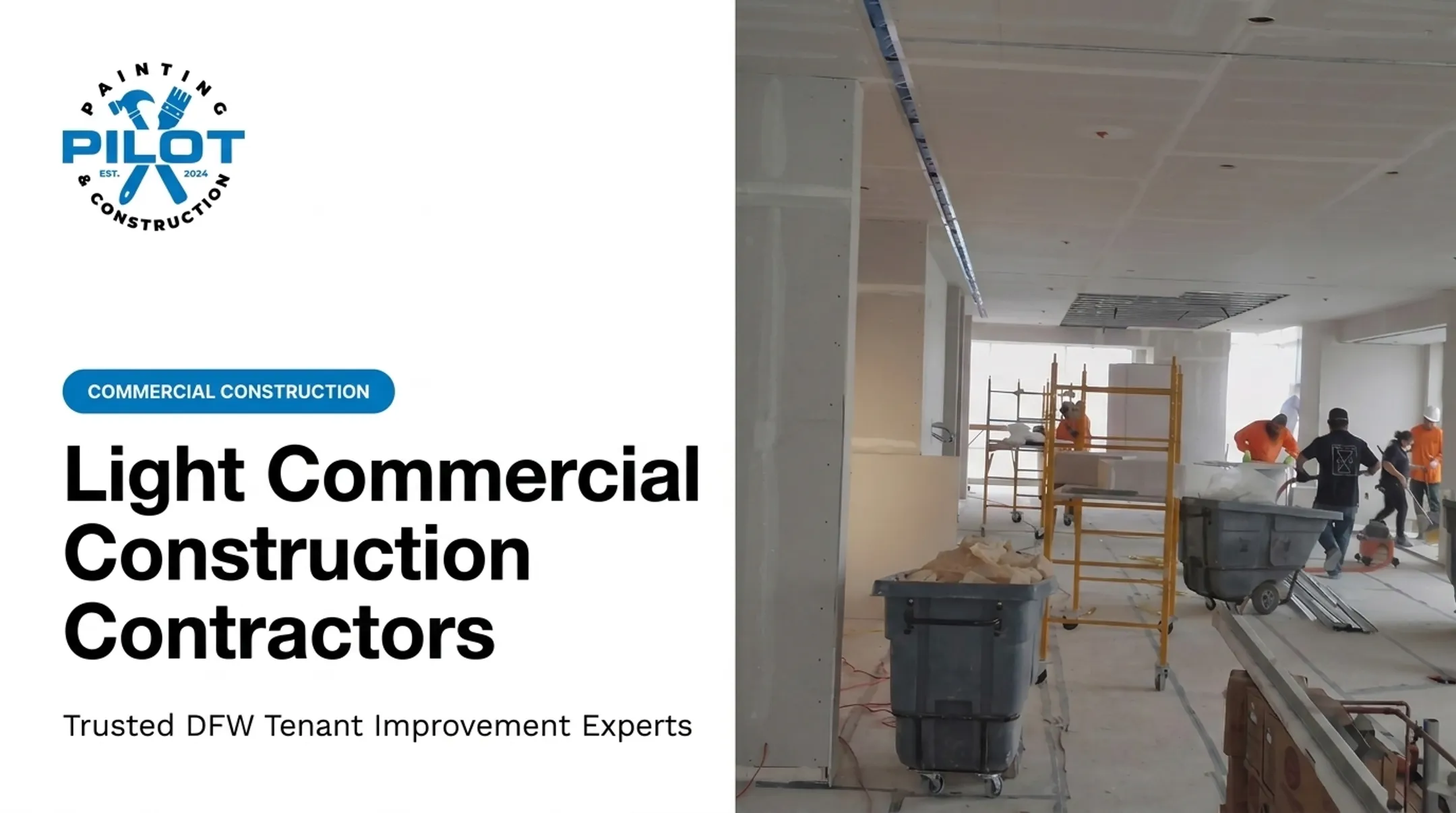
Pilot Painting & Construction handles this full range for commercial clients, including whitebox remodels that prepare a leased space as a clean, functional blank canvas for the next tenant. That work typically means stripping outdated finishes and updating core systems so the space is ready to lease with core systems in working order.
The Commercial Construction Process: Step by Step
Every commercial project, regardless of size, moves through a similar sequence.
- Site selection and feasibility — Evaluate zoning restrictions, site access, and existing property condition before signing anything.
- Design, budgeting, and permitting — Architects draft plans, contractors estimate costs, and you apply for local approvals. Local building departments typically require plan review for code compliance before construction begins, plus inspections at key stages.
- Bidding and contractor selection — Compare multiple bids and vet each contractor's experience, communication style, and past commercial work.
- Construction and project management — Coordinate trades, complete inspections at each milestone, and keep your business running while work is underway.
- Final walkthrough and completion — Resolve punch lists, obtain the certificate of occupancy, and take possession of the finished space.

How long does this actually take? There's no single national benchmark for planning-to-completion timelines, since scope varies so dramatically. Commercial and institutional construction backlog sat at 8.5 months as 2025 wound down, according to ENR's industry analysis. That backlog shows how much demand contractors are working through before they break ground on new work.
Financing Your Commercial Construction Project
Most commercial construction gets funded through construction loans that release money in stages rather than a single lump sum.
How draw schedules work:
- Lender and borrower agree on a draw schedule after closing
- Borrower submits a documented draw request when a milestone is met
- Construction-loan administrator verifies the completed work
- Funds release to pay contractors and vendors for that work

Common Financing Options
| Loan Type | Max Amount | Notes |
|---|---|---|
| SBA 504 | $5.5 million | 10-, 20-, or 25-year terms; purchase, construction, or renovation |
| SBA 7(a) | $5 million | Acquire, refinance, or improve real estate |
| Bank construction loan | Varies by lender | Terms negotiated directly with the lender |
SBA's CDC/504 program requires at least 10% borrower equity of the total project cost. Some lenders also market SBA-backed options with down payments as low as 10% for owner-occupied commercial real estate. Final terms still depend on credit approval and underwriting.
Before you start: Align your contractor's bid with the budget and documentation your lender requires. A mismatch between the two is one of the fastest ways to stall a project.
Choosing the Right Commercial Construction Partner
When your business stays open during construction, clear communication is what keeps a project on track and revenue intact. A contractor who disappears for two weeks without an update can cost you customers, not just time.
Look for a partner who offers combined services, including:
- Commercial painting, interior and exterior
- Renovation and tenant improvements
- Drywall repair and installation
- Flooring, floor coatings, and polished concrete
- Parking lot repair and ADA-compliant traffic striping
Managing one contractor across all these trades beats coordinating five separate vendors on the same job site.
That single-partner approach is how Pilot Painting & Construction works. The family-run firm is based in Pilot Point, Texas, and serves commercial clients across Dallas–Fort Worth and North Texas.

Founder Aaron Stavinoha spent years in commercial construction and ran several businesses before launching the company. He built the firm around transparency and clear communication at every project stage.
Clients notice the difference. Michael Brashears of International Capital said of a recent project: "Your crew has done a great job! Terra has been on top of the job since day 1!"
When vetting any commercial contractor, ask:
- How many years of commercial experience does your team have?
- What's your communication process during an active project?
- Can you show a portfolio of similar office, retail, industrial, or restaurant work?
- Do you offer combined services, or will I need separate vendors for painting, flooring, and repairs?
- How do you handle unexpected delays or change orders?
Frequently Asked Questions
What are the 7 types of construction?
Common industry categories include residential, commercial, industrial, institutional, infrastructure, mixed-use, and specialized/special-purpose construction. Each category carries its own codes, permitting requirements, and design standards.
What is an example of a commercial construction project?
A retail store buildout, a restaurant renovation with new kitchen infrastructure, and an office tenant improvement are all common examples. Warehouse expansions and whitebox remodels for lease-ready spaces also fall into this category.
How long does a commercial construction project take?
Timelines range from a few weeks for minor renovations to over a year for ground-up builds. Scope, square footage, and local permitting speed all affect the schedule.
How much does commercial construction cost?
Costs vary widely by project type, square footage, and local labor and material rates. Get a detailed estimate from a contractor before budgeting, since generic per-square-foot figures rarely hold up in practice.
Do I need a permit for commercial renovations?
Yes, in most cases. Building, electrical, HVAC, and plumbing changes typically require permits and inspections, and requirements vary by municipality.
How can I minimize disruption to my business during construction?
Work with a contractor experienced in occupied commercial spaces, and ask upfront about phased scheduling, after-hours options, and progress updates. Clear communication on a live job site keeps your operations moving.